Wednesday, May 4, 2016

Portugal and the Azores with Collette Tours

The six months since my last blog about our CroisiEurope river cruise have flown by, without a blog, and I am once again in hot water with my CEO.  It’s not that we haven’t gone anywhere – we attended our  annual conference for franchise owners on the new Norwegian Escape cruise ship in November, and went to my niece’s wedding in Houston in December.  However, after the New Year, we mostly stayed close to home.

We got back on the road again in April, on a familiarization (Fam) trip to Portugal and the Azores with Collette Tours.  This was a land-based tour with Collette, the oldest tour company in the United States, which specializes in guided travel world-wide.  Esther and I had really enjoyed brief visits to the Azores and Lisbon a couple of years ago as stops on a trans-Atlantic cruise, so when the Fam opportunity arose, we jumped on it.   One nice touch that Collette provides when you book their tour is sedan service from your home to the airport.  
Our own private car to take us to the airport - Collette's famous "sedan service."  Very nice!
The Fam was a condensed version of Collette’s “Portugal and Its Islands” tour, meaning our trip only included the mainland and the Azores and not the regular visit to Madeira, Portugal's other island group.   We flew into Lisbon from Dulles Airport with a connection in Belgium.  This was less than three weeks after the bombing of the Brussels Airport.  Since we were only transferring flights, we never got near the area that was bombed, but the airport appeared to be operating normally.

We arrived in Lisbon after our overnight flight and were picked up at the airport by a Collette driver and transferred to the Altis Grand Hotel, a very nice hotel with a great location in downtown Lisbon near the old town area.  We were met in the lobby by the Collette Tour Manager, Maryse Blouin, who filled us in on the schedule and gave us information about the tour.  Collette has a reputation for putting their guests in good hotels in excellent locations, and the Altis Grand lived up to that.  Esther and I walked from the hotel to the main avenue, Avenida da Liberdade, a beautiful wide street that is home to all of the upscale shops.  The street slopes down to the Tagus River, and ends at Rossio Square, a large plaza surrounded by restaurants, cafes, shops and the train station.


Rossio Square in downtown Lisbon  (This is one of only a few photos 
in the blog that I didn't take. You'll know when you see them.)

On the first night, Collette took the entire group to a local restaurant for a welcome dinner of local favorite dishes accompanied by wine (included in the tour cost).  Maryse explained some of the dishes and gave excellent recommendations.  Esther and I had the Monkfish Rice with Prawns, which was outstanding.  Wine was included with dinner, and was not limited to a single glass.  We knew we were going to enjoy this tour!
Our Collette menu - a nice touch.
As the Tour Manager, Maryse made sure everyone was checked into the hotel, received all the information about our schedule for dinner and the tour the following day.  She is a full-time Collette employee and has been with the company for 10 years.  This is another differentiator between Collette and many other guided travel companies – their Tour Managers are employees and not contracted guides. 
Esther with Maryse, our wonderful Tour Manager 
After breakfast at the hotel (included every day), we boarded our coach at 8:30 am to begin the day’s touring.  Our group had a total of 26 people, including five Collette employees, two from the UK office, and three from their US headquarters in Providence, Rhode Island.  The rest of us were travel agents or companions of a travel agent.  We appeared to be pretty representative of the typical travelers on Collette’s tours, which they stated have an average age of 64.   Good thing Esther and I were there to bring the average down.  The Collette crowd was also younger, with three 20-somethings and two that were over 30.  
The Collette group, from left to right - Ashley from US; Hannah and Will from the UK office; Michelle from US; Maryse, our Tour Manager; and Carol from the US.

Although Maryse was the Tour Manager, responsible for all logistics and herding the group around, Collette also uses local guides for the tours.   Since Maryse has been doing this for 10 years, she knew most of the information passed on by the local guides.  Our first day, our local guide was Dulce, and she pointed out the city highlights as we made our way out of downtown and headed for Sintra, a charming little village in the mountains northwest of Lisbon.  

We loved the black and white tiled sidewalks and plazas all over Lisbon - the white is limestone and the black is volcanic rock.

On the drive out of Lisbon, Dulce pointed out the Aguas Livres Aqueduct, built in the 18th century.

Unfortunately, the rain began and our free time of one hour in Sintra was cold and wet.  Sintra is the home of the Pena Palace, the summer residence of Portuguese kings for six centuries.  Esther and I saw this magnificent palace on our previous trip to Lisbon, but it was not part of our tour, so we toured the smaller, but still impressive Palace of Sintra in the downtown area.
The Palace of Sintra 

A large meeting room in the Palace, with amazing tile walls.

This is the Pena Palace above the town of Sintra - we saw this on a previous trip to Lisbon.   AWESOME!

A word about the weather – before we left, we looked at weather forecasts for Portugal and the Azores, and they were bleak.  Rain was predicted pretty much for every day we were there.  But the weather gods smiled upon our group, and except for our stop in Sintra and a couple more brief showers, the rest of our touring was blessed with mostly sunny and dry weather. 

As we drove away from Sintra, the rain stopped, and we proceeded to the coastal resorts of Cascais and Estoril, with a photo op stop along the coastline. 

This is the western-most point in Europe, not counting the UK

In Cascais, we had piri-piri chicken for lunch, a local favorite consisting of grilled chicken with piri-piri hot sauce.  Our guide Dulce gave directions to the best gelato shop in town, and most of us ended up there before getting back on the bus.  

They refer to this area as the Portuguese Riviera.

Beautiful avenue through the middle of town.

When we returned to Lisbon, we visited St. Jerome’s Monastery, the Tower of Belem, and the Monument to the Discoveries, all main tourist attractions.  
St. Jerome's Monastery

The Tower of Belem

We also got a good look at the 25th of April Bridge, which looks pretty similar to the Golden Gate Bridge in San Francisco.  Above the bridge on the opposite side of the river is the Monument to Christ the King, which reminds you of the Christ the Redeemer statue high above Rio de Janeiro in Brazil.

25th of April Bridge - named for the date of the Portuguese Carnation Revolution in 1974.  Note the Christ the King Monument above the bridge to the right.

We got back to the hotel with a few hours before our scheduled group dinner.  Since the weather was sunny and clear, we walked down the Avenida da Liberdade and hopped on the funicular that took us up to the Bairro Alto district and a park with great views of the city and St. George’s Castle across the way.
 
The funicular 
St. Georges Castle on the hill

View of the Baixa area - the old town - and the Tagus River.  The Cathedral can be seen to the top left - construction began in 1147.

Although normally the evening dinner show is an optional extra to the tour, Maryse decided we should all go and Collette included it at no charge for us.  The restaurant was an interesting venue, set down below street level with an arched ceiling supported on stone columns.   Dinner was a choice of fish or steak, and was OK, but we weren’t there for the food.  We were there to hear the fado music – a form of Portuguese singing known for being very emotional and melancholic.  Think country music in the USA but WAY more expressive.  We had two singers, one male and one female, and they sang in Portuguese, so we could only guess what tragedies they were singing about.  But they both looked tortured as they sang, so we knew it was bad.   
No, she isn't witnessing a murder - she's just singing fado.
Day Two began with a trip to Fatima, the small village where the Virgin Mary appeared to three young shepherd children on May 13, 1917, and then again on the 13th of every month through October 13, 1917.  The site is now one of the most visited pilgrimage locations in the world for Catholics. Perhaps because I was raised a Catholic, the grounds felt holy and moving to me.  I lit a candle in the chapel for my mother, who passed away only two months before.

The chapel marking the spot where the apparitions occurred.

The Basilica of Our Lady of the Rosary at Fatima

The new Church of the Holy Trinity completed in 2007 to accommodate the enormous numbers of pilgrims visiting Fatima.

A statue of Pope John Paul II
Our next stop was a quick visit to the Monastery at Batalha (which means "battle").  The Portuguese won an important battle against Spain here in 1385 despite being heavily outnumbered.  The Monastery was built by King John I of Portugal to thank the Virgin Mary for the victory.  It's kind of in the middle of nowhere and you come upon it rather suddenly.

The Monastery of Batalha definitely falls into our ABC category - Another Beautiful Church
Amazing to think this construction was done in over 100 years from 1386 to 1517.  (We're having trouble with our contractor on a single-story house!)
From Batalha, we headed to the coastal town of Nazare, one of my favorite stops.  We rode on the funicular with Maryse to the old village on top of a cliff overlooking the beautiful wide beach.
The funicular tracks to the top of the cliff.


Gorgeous views from the top of the cliff.
Me and my best girl (and CEO)

The church in the old village.
The church didn't look like much from the outside, but the inside was a revelation.
Incredible workmanship and the ever-present blue and white tile work we saw everywhere in Portugal.

Quite an impressive altar!
We had time on our own for lunch, so Esther and I went back down the funicular and walked along the waterfront till we found a local restaurant.  Esther wanted a local dish so we ordered a fish stew to split.  Very little English was spoken and we were the only foreigners in the place.

We weren't completely sure of what kinds of fish were in this dish, but it was tasty.

Then it was back on the bus to head to Obidos, a remarkable walled city dating back to Roman times. We were reminded of the walled city in Dubovnik, Croatia or the medieval town of Eze, near Monte Carlo.  As we often see in our travels, some of the more interesting sites have developed into tourist traps, and Obidos fit the profile.  The two main streets are loaded with souvenir shops and cafes.

This is the city gate, adorned with azulejo, which is tin-glazed ceramic tile work.

Looking over the town from the castle walls.

One of the main streets through the town.
Maryse told the group that Obidos was the best place to buy cork products.  Portugal is the largest producer of cork in the world, and they make a huge variety of cork products.  The women in our group typically went for the handbags and cork jewelry.  I bought a cork ball cap, just because I had never seen one before.   More about the cap later.

My cork ball cap.  Bet you don't have one!
We also paid one Euro each for a shot of ginja in a chocolate cup, which is another thing to do in Obidos.  Ginja is a Portuguese liqueur made from ginja berries.  Naturally, we added a bottle of Ginja liqueur to our collection of alcohol from around the world.

Dinner was on our own back in Lisbon, and Esther and I walked downtown from the hotel and shared a pizza, some pasta and a bottle of wine.  Portugal is a very affordable country to visit -  food and wine were quite reasonable.

Then we ran into the Collette team back at the hotel and joined them in the rooftop bar.  The wine was even more reasonable in the bar, because Collette bought a few rounds. The whole team was very friendly and hospitable and we really enjoyed hanging out with them. Will in particular was popular with the lady travel agents - 26 years old, good looking, and charming - and the British accent didn't hurt at all!

We got up early the next morning and boarded the coach for the airport.  The next part of the tour was on the island of Sao Miguel (or St. Michael), the largest of the nine volcanic islands that comprise the Azores.   We flew into Ponta Delgada, the largest city on the island, and checked into the Royal Garden Hotel, which again was very convenient to the downtown area.
The view from our hotel room at the Royal Garden Hotel in Ponta Delgada

After check-in, Maryse introduced us to the local guide, Maria, who walked us through the downtown area and pointed out the major attractions.
The Forte de Sao Bras, along the waterfront, now the military museum of the Azores.

Church of Sao Jose (Saint Joseph)

The City Gates at the main square in downtown Ponta Delgada.

The Church of San Sebastian - very ornate carvings around the doors.

Portuguese retired guy?

Our group following our guide through the streets of Ponta Delgada - notice the ever-present black and white stone tiles.
Our local guide, Maria - we had her for three days in the Azores and she was excellent!

The main avenue along the waterfront - in the Azores, the sidewalks are black stone with white stone accents, vs. Lisbon, where they have white stone with black stone accents.  That's because the Azores has lots of black volcanic rock, and the mainland has the white limestone readily available, so they export to each other.

This is the Monument of the Immigrants

The Flag of the Azores - the nine stars represent the nine islands in the Azores, and the bird is a golden goshawk, which is called "acor" (pronounced  A-shore), thus the name of the islands.  However, the birds were mistakenly identified - they were not goshawks, but a subspecies of the buzzard.   Azores sounds much better than Buzzards to me.

After the city walking tour, we boarded the coach for a short drive into the mountains.  Nothing is too far away on the island of Sao Miguel - it is only 40 miles long and 5 to 8 miles wide.  Our destination was a valley and a little town, both named Sete Cidades, or Seven Cities.  The town is located along the banks of one of the twin lakes of Sete Cidades, which are in a volcano crater.  We got our first look at some of the amazing scenery on the island.


The Twin Lakes of Sete Cidades - the far one is the blue lake and the near one is the green lake.  The village can be seen in the top left corner.

A pretty little church in the center of the village.

A trio of local ladies leaving church.

One of the travel agents in our group had a one-way conversation with this lady in her garden - neither of them understood the other, but they both enjoyed the talk.

The incredible view from one of the miradouros (English translation - scenic overlook), with the coastal village of Mosteiros in the background.

Collette took us all to dinner on our first night in the Azores at the Mariserra Restaurant, where we had the shrimp and rice stew plus beef on a skewer. By now, the fourth night of our tour, we had become a pretty friendly group.  Aided by free-flowing wine, 21 travel agents and the fun-loving Collette folks got kinda rowdy.  Gloria (last name withheld to protect the innocent) decided to pass out shots of different local liqueurs, and we got even rowdier. The coach ride back to the hotel was a lot of fun (that's what they told me the next day).  We didn't make it to the hotel bar that night.

Gloria, AKA "the trouble maker," drank me under the table.  

Everyone made it on to the coach on time the next morning, and we headed for the Furnas Valley. But first, Maryse took us to a large supermarket, so we could pick up Portuguese groceries.  She knew her group - a lot of money was spent in the store, for wine, spices, hot sauce, etc.  

Wine was cheaper than soda, so we bought some to save money. 

On the way to the Furnas Valley, we got more exposure to the beautiful scenery and landscapes.  We also stopped at a tea plantation and sampled the local tea.

Views like these drew comparisons to Hawaii and New Zealand from the group.

The tea fields at the tea plantation.

Another miradouro to observe Lagoa das Furnas (Furnas Lake).

Our arrival in the village of Furnas brought an unpleasant sulfuric odor, resulting from all the hot springs, which bubbled and released steam.  We proceeded to the lakeside to watch our lunch being cooked by the geothermal heat.  The dish is called cozido, a traditional stew of meat and vegetables, which in Furnas is placed in large pots and boiled underground.
 Volcanic hot spring in the village of Furnas.

Our cozido lunch is pulled from its hole in the hot ground.

Another Collette extra - our own private lunch area complete with passed hors d'oeuvres and, of course, wine!  All included with the tour.

This is the typical cozido serving, with vegetables, beef, pork and chicken - and they came by to offer seconds!  

After lunch, we visited the Terra Nostra Park, a botanical garden which is highlighted by a thermal water pool filled with minerals.  Maria told us the color was caused by iron in the water.

The thermal water pool in the Terra Nostra Park.

I had removed the cork ball cap I bought in Obidos when we sat down for lunch, and forgot it when we left.  I realized it on the coach and told Maryse, and she let Maria know.  This was my second lost item, as I left my Kindle e-reader on the plane from Lisbon to Ponta Delgada.  I was becoming high maintenance for our tour director.   After we finished walking through the botanical garden, Maria told me she was going to go see if she could recover the cap.  She re-appeared as we were boarding the coach, but was shaking her head with a sad look.  Then she grinned and pulled my cap out from behind her back!  Those Portuguese are real kidders!
Maria brings back my lost hat! 

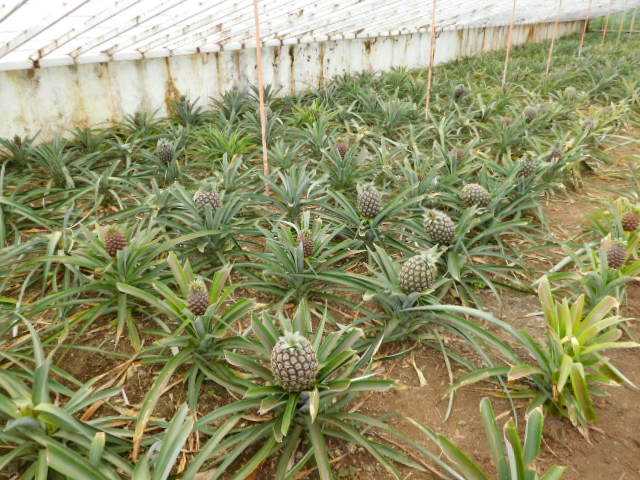
Our last stop was at the pineapple plantation, which wasn't at all like you would expect.  The Azorean pineapple, or ananaz, is grown in a greenhouse, and this "plantation" was near downtown Ponta Delgada.

In the Azores, pineapples are grown in greenhouses, where it takes 2 years to grow from flower to fruit.
Azorean pineapples are known for a small crown and intense flavor.  
There was, of course, a gift shop selling all things pineapple.

That night, dinner was on our own, so we walked to a restaurant recommended by Maryse, only a couple of blocks from the hotel.  We ran into Will and Hannah from Collette and some of the other travel agents and all sat together.   Will informed us that dinner was on Collette, and that included a bottle of wine, which by now you may see was a common theme at meals.  

The working portion of the trip.
Esther and I decided to skip the optional whale watching excursion the next morning, so we had free time up till 3:00 PM.  We did some more walking around Ponta Delgada, did a little shopping for lava stone jewelry, and checked out the big mall in town.  We sat on an outdoor terrace with a view of the city and drank a couple of beers, which cost a total of  E1.80 (about $2).  At 3:00 PM, because this was a working trip (which we do to serve you better!), we attended a presentation about Collette Tours, given by Will with some help from Ashley, and both did an excellent job.   After the presentation, we went by coach to the Museum of Sacred Arts.
The Museum of Sacred Arts is Ponta Delgada

The amount of carved cedar woodwork on this altar was stunning - we have never seen anything like it!


We had another Collete-provided dinner that evening at the Paladares da Quinta restaurant. Prior to dinner, our host/waiter/comedian entertained us by showing us how to make a Portuguese aperitif with white Port wine, tonic, a slice of lemon and a mint leaf .  He solicited audience participation, and I obliged.


Our host and cocktail-making instructor at dinner - he was a natural comedian and very entertaining.

Esther loved the aperitifs!

The dinner was probably the best one we had during the trip.  However, after the aperitifs, we only drank water.

JUST KIDDING!!  We had a lot of wine.  Then we went back to the hotel and joined our Collette hosts and fellow travel agents in the hotel bar to continue the party.

On our final day in the Azores, we visited a ceramics factory (yawn), drove to one of the highest spots on the island for more incredible views, and stopped at Lagoa do Fogo (Fire Lake).
Our guide for the day, Gabriela, explains the process at the ceramics factory.


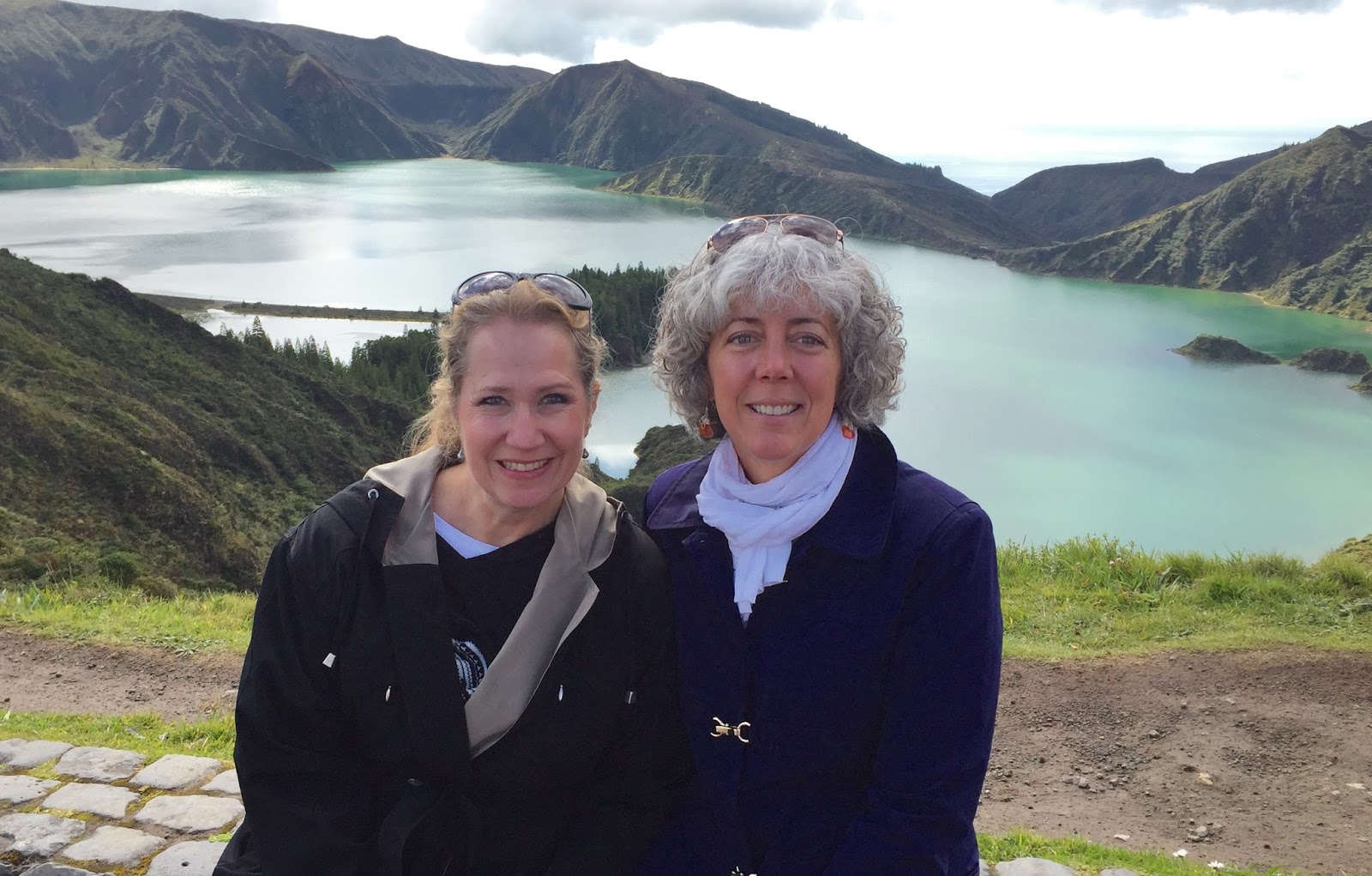
Lagoa do Fogo - Fire Lake - surrounded by mountains.  This evoked memories of Alaska for me.

We proceeded on to Ribeira Grande, the second largest town on the island, on the north shore.  Of course, there was another beautiful, if small, church (ABC), and some interesting architecture. However, the highlight here was the liqueur shop, where we got to sample about a dozen different flavors.  And thanks to our group, I'm sure the Mulher de Capote had a profitable sales day
The town center of Ribeira Grande, with the Bridge of Eight Arches in the background.

This was the name of the liqueur shop - the capote is a large hooded cape traditionally worn by Azorean women.

Those are all airplane-size bottles of Portugues liqueurs - we bought a 10-bottle sampler!

I just liked the color, light and shadows along this cobblestoned street near the liqueur shop.

We headed into the northeast part of the island and stopped at a park with old stone mill buildings and waterfalls, then made one last stop in the village of Nordeste (which means northeast) to stroll around and sample the local pastry.

As if we hadn't seen enough natural beauty on the island - the Azores have waterfalls, too.  This is in the Ribeira dos Caldeiroes Natural Park in the northeast part of the island.

The streets of Nordeste

On the return trip to Ponta Delgada, we passed an island formed by a volcano crater that Gabriela told us is a popular spot, because when the tide is low, the water in the crater is very shallow.

This is what we saw from the coach.

We were on our own for our last night in the Azores, so the Boss and I headed downtown to try out a seafood restaurant that Maryse recommended.  We chatted with the waiter about what to order, and he took us to the display case with the day's fresh catch on ice.  He suggested the parrotfish, which we have often seen snorkeling or during scuba dives, but had never eaten.  Combined with a bowl of clams in garlic butter, and a bottle of wine, it was a delicious meal, all for about $60.

Our parrotfish right off the grill - we thought we'd never eat it all.
But we did - except for his head!

We flew back to Lisbon the next morning, and returned to the Altis Grand Hotel.  We had the rest of the day on our own to do a little final shopping.  While we were in the Azores, Maryse had made some inquiries with Sata Airlines, which we flew back and forth to the Azores from Lisbon, about my lost Kindle, but with no luck.   She suggested I ask Guest Services at the hotel if they could contact the airline and find out anything.  A young trainee spent hours making calls and eventually informed me that my Kindle was in the Azores (from which we had just returned) but they would put it on a plane to Lisbon that night, and I could pick it up at the airport the following morning when we left the country.  Amazingly, I got my Kindle back.

Collette hosted a farewell dinner for the group on our last night, at the Faz Figura restaurant in the Alfama district.  We had a private room with a view of the Tagus River, and by now, everyone knew everyone else pretty well.  And we had wine. We then returned to the hotel and met up at the bar for a final party and to say farewells.  There was a lot of hugging and promises to stay in touch.

Our last night in Lisbon at the hotel bar - Esther with Michelle, Hannah and Will from Collette.  

This was our first extended land-based guided travel, and we loved traveling with Collette.  Granted, we had the benefit of the additional Collette staff that came along as part of the Fam, so on a typical tour, you will probably be responsible for your own bar bill.  But our tour included six dinners, all in local restaurants (not hotels) with free-flowing wine, and breakfast every day.  This is pretty typical.

We only stayed in two hotels, and both were nice and in excellent locations. The dynamic of guided travel in a group results in connecting with your fellow travelers, and that is always fun for us. Many of group had done tours with Collette in other locations, and had great things to say about them. Finally, we had a fantastic Tour Manager in Maryse.  She was very organized, took great care of us, got along with everyone so well, and had a wealth of knowledge to share.  All of her recommendations for things to see and do and places to eat were spot on.  By the end of the trip, we felt like we made a good friend that we would love to travel with again.

I stole the following from Will's Facebook page, something he posted at the end of the trip:

"So as I get ready to leave Portugal tomorrow, I have taken a moment to reflect.  Reflect on what I have learnt, seen and experienced.  I have to say at every turn this country and its islands have completely astounded me.  Not once was I bored, not once did the view not take my breath away. The history of this country is incredible, I never knew how valuable some of the contributions to the world were!! The people and their culture are just fantastic, constantly joyful and very welcoming.  I will be sad to leave this country tomorrow and will definitely be coming back!! Thank you Portugal."

Well said, Will!


Any and all comments and questions are welcome and encouraged.

Monday, November 2, 2015

Cruising with CroisiEurope in France


The Rhone River in Tournon, France
One of the benefits to being a travel agent is the opportunity to experience a variety of travel options from different suppliers.  The Boss and I just returned from a 7-night river cruise in the Rhone valley in France on The Camargue, a river cruise ship owned by CroisiEurope.  Croisi is actually the largest river cruise line in Europe, but is largely unknown to the North American market.   We travelled with about 40 other travel agents to get a first-hand look at what Croisi has to offer.

The Camargue - one of CroisiEurope's new ships with 104 passengers.
This was our third river cruise – the last two were both on AmaWaterways, a company that is a bit more upscale than Viking, which is probably the most recognized company in the US for river cruises.  As many of you may know, river cruising is a totally different experience than ocean cruising.  The ships are small, typically carrying between 100 and 200 passengers.  The size limitation results from the fact that most river cruises require passage through locks on the rivers, and the ships cannot be wider or longer than the locks.  A river cruise is much more about the destinations than the ships, and a river cruise provides scenery on both sides of the boat 24 hours a day, with at least one stop per day and sometimes more.  A river cruise is more comparable to a land tour, except that the ships serve as a floating hotel, so you don't have to pack and unpack every day or two. Our experience so far is that the ships are pretty similar, layout and feature-wise, with some variation in length and therefore number of cabins.

One of the key elements in Croisi’s marketing strategy is a considerably lower price point than similar Viking or AmaWaterways cruises.  The price of the cruise we just took was about 50% of the cost of the same cruise on AmaWaterways, or a savings of about $4,500 per stateroom.  That’s real money.  In addition, Croisi is more all-inclusive than Viking or AmaWaterways, although with some limitations.  While all of them include beer and wine at lunch and dinner, Croisi also includes unlimited beverages at the bar throughout the trip.  With the largest fleet in Europe, Croisi has a more extensive list of itineraries than their competition.  So if you have done the Rhine and the Danube and are looking for lesser-known rivers and destinations, you might find them at Croisi.

Because we knew their price was substantially lower than competing river cruise lines, our expectations were not high.  We have found in our travels that you usually get what you pay for.   Overall, we were pleasantly surprised.  The ship was new and was bright, comfortable and well-maintained.

The lounge on the main deck with bar in the middle.
Our stateroom was comparable to other ships.  The bathroom was a good size, and we had large picture windows along the entire length of the stateroom.  Closets were a bit small, but OK.  The TV was ceiling-mounted and with a press of a button you could fold it up into the ceiling and out of the way.  Unfortunately, other than CNN, there wasn’t really much to watch in English.

Our stateroom with large picture windows and drop-down TV - not crazy about the twin mattresses pushed together.
The staff on the ship were very friendly and helpful and worked hard, because they did multiple jobs.  Our bartender at night in the lounge was also making up staterooms in the morning.  (She was a much better housekeeper than bartender.)  Our ship had about 100 passengers, and we probably only interacted with about 10 crew members between the lounge, front desk, housekeeping and dining room.  The captain made one or two brief appearances.  Our favorite crew members were Ezster and Tomas (can you guess why?), who both worked in the dining room.  Ezster loved the iPhone case with the big letter “E”on Esther’s phone, and was moved to tears when Esther gave it to her on the last evening. 

From left - Tomas, Esther, Ezster and Tom
For the most part, the food was excellent – very French at every meal.   The breakfast buffet was disappointing if you were looking for typical American food.  The only eggs were scrambled (I think), but looked too strange to eat, and - this may ruin it for Americans - there was NO BACON! A great selection of croissants, bread and pastries kept us from going hungry. Coffee was very strong.

Lunches and dinners consisted of a set menu, typically an appetizer or salad of some type, followed by the main course, and then a dessert.  Our cruise featured duck (twice), veal (twice), fish several times, venison, pork and beef.  Some passengers requested a substitute for the main course if they didn’t want it, and the staff happily obliged, usually with some kind of chicken.  The dining room had the same three wine choices at every meal, one white and two reds.
The duck pate appetizer - very nice presentation.

We usually went through a couple bottles at each meal.
We felt there were some things that suffered in comparison to our previous trips.  We had been told that we would be provided transfers from the airport to the ship, and because we arrived early in the morning and boarding was not till late afternoon, we were going to have a day room in a hotel in Lyon to rest and freshen up.  First, we sat at the airport for about an hour and a half waiting for additional cruise passengers to arrive on a later flight.  Then, we were bused to a parking lot in the city and had to drag our four suitcases a couple of blocks to the hotel. Our day room was actually one of two reserved for about 20 travel agents, so we were sharing the room with about eight or ten others.  When it was time to go to the ship, we again dragged our bags the two blocks through the city back to the bus. To be fair, this may have been something Croisi set up for this travel agent sailing, and may not be the norm.

We missed the coffee/latte/cappuccino machine in the lounge that our other ships had.  Our room was only made up once a day – no turn down service at night.  Although cocktails were included in the lounge, the bartender didn't know how to make a dry gin martini on the rocks, and they had no olives. A professional bartender would be a welcome addition.  I mentioned the breakfast buffet and the lack of menu choices at lunch and dinner, which didn’t bother us so much, but could be an issue for North American travelers.  Tables had a little placard designating whether they were for the French or the English speaking passengers.  A larger wine list or some variety in the wine choices, as we have seen on other ships, would be nice. Only one brand of beer was available, a French beer named Meteor. The alcohol brands were decidedly not top-shelf.  The vodka was Mulligan's - good luck finding that in your regular watering hole. The free wi-fi was so spotty and slow that we could rarely use it.  So yes, the cost is all-inclusive, but there were limitations on those included items.  

Entertainment was unremarkable, to say the least.  One guy played an electric keyboard and sang in the lounge most nights, but he spoke no English.  We had cultural dancers one night and they were actually boring.  A matronly French woman sang French songs one night and was largely ignored by the Americans on board.  And the Crew Show, which had only one or two amusing moments, demonstrated that the small crew was decidedly short on talent. Finally, because this is a French company, all announcements are made in French first, then English.

The Crew Show - Olga, on the right, also worked the bar and made up rooms.
But after unlimited wine and beer at dinner, the evenings were generally pretty lively in the lounge. Dancing the first night was inspired by a French couple in their 80s who showed remarkable energy and got many of us to join in.  They spoke no English but through sign language and drawing numbers on the table with their fingers, we determined that they had been married 63 years and had 24 grandchildren.  Esther thought they were darling, and wondered if we would be like them at the same age.  I said "Yes, but taller."  Seriously, neither of them looked to be 5 feet tall.

This French couple kicked off their shoes and got the dance party started!

I had to teach the French guys how to do The Twist.
Croisi compared very favorably with the included tours on the itinerary.  We had at least one tour every day, and they were excellent, with very good English-speaking guides.  However, unlike our previous trips, we had no choices of tours.  Everyone went on the same tours.  One other note - tours are normally conducted in multiple languages unless there are at least 20 English-speaking guests that can do an English only tour.  We had so many English speakers that two out of the three tour groups each day were done in English, and only one group did the tour in French. This won't always be the case, and tours where the guide says everything in French, and then translates everything to English, are more difficult to enjoy.

Our itinerary started in Lyon, which recently surpassed Marseilles as the second largest city in France.  Lyon is located at the confluence of the Rhone and Saone Rivers, and had a lot of interesting sights and history.  In Lyon, we saw the Basilique Notre-Dame de Fourviere, which sits on the highest hill overlooking the city; we saw the painted murals on building walls which the city is famous for; the traboules, long passageways that connect parallel streets and wind their way through buildings and courtyards in between; and La Tour Rose (the Pink Tower).

The Basilique Notre-Dame de Fourviere can be seen from miles around.

An incredible mosaic mural inside the Basilique.
La Tour Rose - also our Lyon refrigerator magnet selection.
One of several painted wall murals in Lyon.

Passing through one of the traboules in Lyon.

After Lyon, our stops included Macon (on the Saone River), where we took a bus to tour the Abbey of Cluny, founded in 910 AD.  For several hundred years, the three successive churches built at Cluny formed the largest building in Europe, until St. Peter’s Cathedral was rebuilt in Rome in the 16th century.
A model of the Benedictine Abbey at Cluny, at its height, the largest church in the world.

Only small portions of the Abbey remain today.
From Macon, we sailed to Trevoux, a tiny village along the Rhone, followed by Vienne. Vienne was a Roman provincial capital, and numerous remains of Roman construction are still visible.

Imperial Temple of Augustus and Livia, almost 2000 years old. 
The Cathedral Saint-Maurice.  The Boss and I call this ABC - another beautiful church.
Our next stop was Arles, which may have been my favorite destination.  Arles also has a rich history with Roman ruins, including the Amphitheatre, kind of a mini-me of the Coliseum in Rome.

The Amphitheatre in Arles.

The actual cafe terrace in Arles.
Cafe Terrace at Night, by Van Gogh


Only the most important places in town are on the sign.
After our tour of the city, Esther and I skipped the venison lunch on the ship and went back to an outdoor café in town for a salad, pizza, and 100 cl of wine, because 25 cl didn't seem like very much. Turns out, 100 cl is equivalent to a quart (about 1-1/4 bottle), which is a lot to drink at lunch. Because we needed to make it back for the next tour, we didn't have time to finish it, which made the Boss sad. We then boarded a bus for our afternoon tour of an olive farm outside of town, which included a ride on a cart pulled by a tractor, olive tapenade tastings, and a visit to the farmhouse.

About to set off on our tour of the olive farm outside Arles.  We ended at the table full of samples in the background.
Picturesque farm house at the olive farm.
Next was a trip to the Camargue region (which was also the name of our ship).  The Camargue is like the French version of the Everglades, located south of Arles in the Rhone delta where the two branches of the Rhone River reach the Mediterranean Sea.  The Camargue is western Europe's largest river delta and is a vast plain comprising large brine lagoons cut off from the sea by sandbars, encircled by reed-covered marshes, and surrounded by large cultivated areas.  The Camargue is one of the few habitats in Europe for flamingos.  We also saw large herds of bulls, being raised for export to Spain’s bull rings, and white horses known as the Carmarguais, one of the oldest breeds in the world.  The bus stopped in Saintes-Maries-de-la-Mer, the capital of the Camargue region before returning to the ship.

Fighting bull being raised for export to Spain.
The Camargue is a natural habitat for flamingoes.

When in France, you must have pommes frites (French fries) at least once!

Sunset over the Rhone at Arles before sailing.
From Arles, we turned around and headed back north on the Rhone to Avignon, where we received a tour of the Pope’s Palace, or the Palais des Papes.  We learned that Avignon served as the seat of the Catholic popes from 1309 to 1377, before moving back to Rome.   The city is still surrounded by its medieval stone walls.

The Palais de Papes (Popes Palace) in Avignon.
Our tour of the Palace naturally ended at........ the gift shop, of course!

The medieval walls still surround parts of the old city.
The ship sailed that evening and docked in Viviers, a tiny walled village on the right bank of the Rhone.  We arrived at night, and took a walking tour in the rain through the medieval center of town to the Cathedral of Saint-Vincent at the top of the hill.

Walking through the medieval cobblestone streets in the rain - actually a pretty neat experience.
On our last day of cruising, we arrived in Tournon, and had a walking tour followed by a wine tasting in the castle, which was great fun.  We bought a couple of bottles of wine made in the local vineyards across the Rhone.  They were a Syrah-based blend created by the woman hosting the wine tasting who was a friend of the vineyard owner.  It’s always fun to bring something home that reminds you of your trip.

The Castle Museum and our guide.

The town of Tournon from the castle terrace.

We tasted wine from this vineyard across the river.
We bought this - in spite of the odd spelling.

Not sure why I like this picture so much, but I do.
On the castle terrace in Tournon overlooking the Rhone River.
We always say half the fun of traveling for us is meeting fun and interesting people.  As we walked into the lounge the first evening, a woman seated at the bar asked Esther “Are you a travel agent too?’’  Within minutes, Esther and Jeri determined that they had not only the same birthday, but about 20 other things is common, and we ate and drank with Jeri and John from California quite a bit.  Many of the travel professionals on board were in their 20’s and 30’s, so they were a lively group and we spent a fair amount of time with them as well.  We enjoyed Barney and Anne, also from California.  Barney is a native Australian and he and I traded good-natured insults and banter all week.  The Croisi marketing and sales people on the trip, Nicola, Cindy and Sara, are passionate about their product, and took good care of us.

In summary, if you always wanted to do a river cruise, but thought they were too expensive, CroisiEurope could be a good option for you.  Unless you want a full French immersion experience, though, you should probably go with friends or in a group. We had a good time on this trip - I mean, really, what's not to like?  A floating hotel on the river, charming French towns and villages, interesting and educational tours, good food, plenty of wine, fun people and new friends.

CroisiEurope also offers more affordable barge cruises, which typically have 24 or less passengers and 6 staff, and travel slowly down rivers and canals.  They are also all-inclusive with meals, beverages and tours. We are intrigued enough by these to think we may organize a barge trip for 2017.  Let us know if you want to go!  Here is a link that provides a more information on this unique travel experience:  http://www.croisieuroperivercruises.com/cruises/barge-cruises

As always, all questions and comments are welcome.